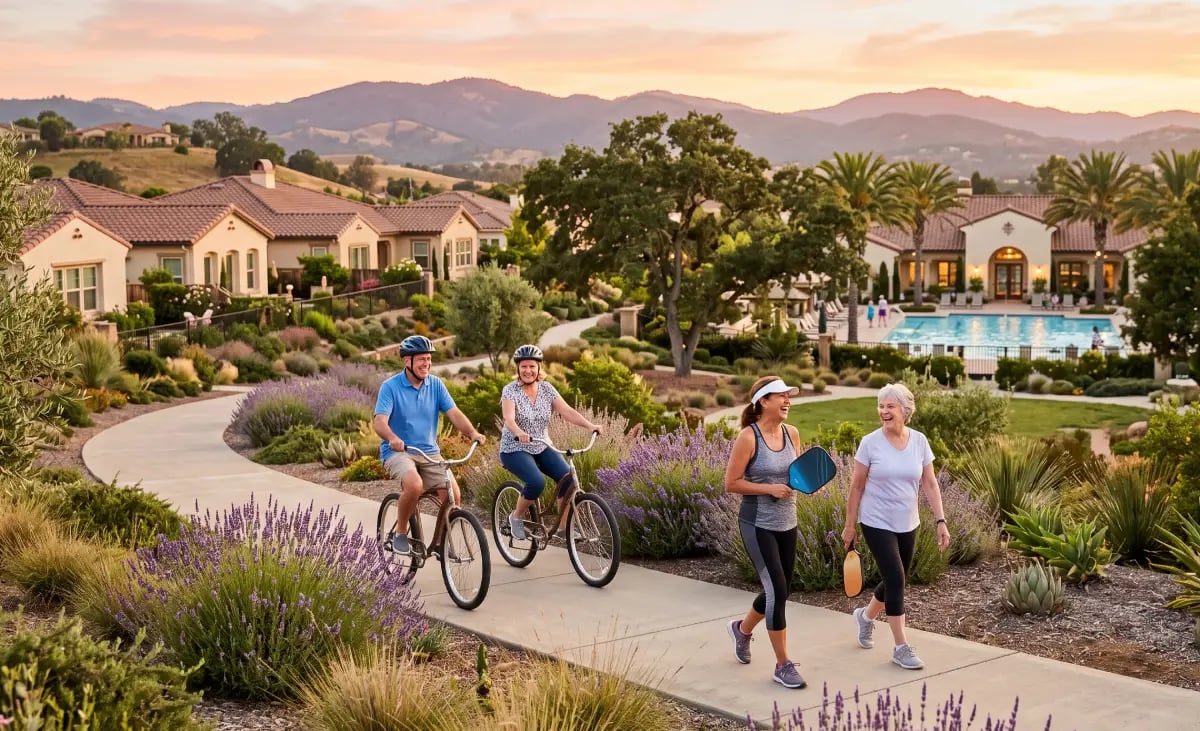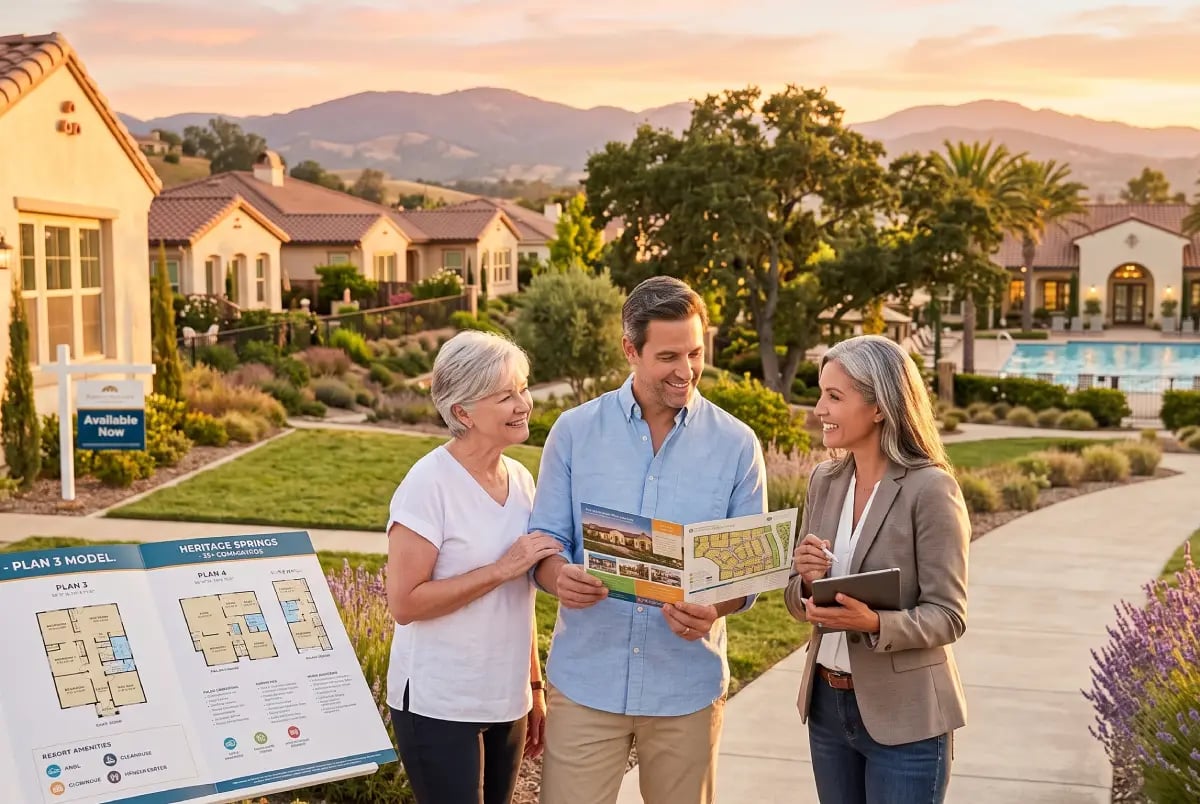
A buyer touring Sun City Roseville in the morning and Esplanade at Turkey Creek in the afternoon walks away with a simple impression: the new community is more expensive. Newer clubhouse, newer kitchens, newer everything. In March 2026 the median sale price inside Sun City Roseville came in at $550,000, while Taylor Morrison was quoting Esplanade single-story homes from the upper $400,000s and estate plans up to nearly 3,000 square feet. On paper, the resale community looks like the value play.
That impression survives about ten minutes of arithmetic. The real cost difference between an established Del Webb resale and a new-build 55+ home a few miles up Highway 65 runs in the opposite direction most buyers expect, and it comes from three line items that never appear on a listing sheet: an expired special tax district, a community-owned amenity structure, and a one-time fee that the HOA calls optional.
The Sticker Price Is Not The Cost
Set the two options next to each other with the numbers that actually determine monthly carry.
Line item | Sun City Roseville (resale) | Esplanade at Turkey Creek (new build) |
|---|---|---|
Community size | 3,110 homes, built 1995 to 2000 | Planned 850 homes, currently selling |
Home sizes | 878 to 2,681 sq ft, 25 floor plans, all single level | 1,408 to 2,985 sq ft, single-story |
Recent pricing | Median sale $550,000 in March 2026; average around $377 per sq ft in May 2026 | From the upper $400,000s |
HOA dues | Roughly $192 to $225 per month | Set by builder, subject to change |
Mello-Roos | None; original bonds have expired | Applies to most new Placer County subdivisions |
Amenity ownership | Association owns golf and food service operations | Builder-managed until turnover |
The Mello-Roos row is the one that flips the story. Sun City Roseville was built between 1995 and 2000, and the community financing bonds have already run their course. A buyer at Esplanade or at Trilogy Bickford in Rocklin is stepping into a parcel that still carries a special tax assessment on top of the standard Placer County property tax of roughly 1.0 to 1.2 percent of assessed value. Depending on the district, that can be a four-figure annual line item for the full term of the bonds (read more about the Esplanade at Turkey Creek resale puzzle).
Multiply that difference across a ten-year hold, and the "cheaper" new-build starts to look like a delayed invoice.
The $5,000 Line That Isn't On The MLS Sheet
Here is the piece that catches most first-time Sun City Roseville buyers off guard at closing. The community charges a one-time $5,000 Special Use Fee due at the transfer of title. The HOA documents describe the fee as optional. In practice, it is the price of the Activity Card that gets a resident into the fitness centers, the pools, the ballroom, and the fifty-plus organized clubs (read our overview of what it's like to live in Sun City Roseville).
Every buyer pays it. Treating it as anything other than a mandatory closing cost distorts the underwriting.
For a couple financing a $550,000 purchase, that fee lands alongside the standard escrow items and needs to be sourced from cash reserves rather than the loan. It is small relative to the transaction, and it is easy to miss when comparing a Sun City Roseville offer to a new-build purchase agreement that bundles fees differently. Ask for the buyer disclosure packet early enough that this shows up in the net-cash-to-close calculation and not on the day the wire has to go out.
Why The HOA Dues Look Suspiciously Low
The other number that deserves interpretation is the monthly HOA. For a community with a 52,000-square-foot Timber Creek Lodge, a separate 6,200-square-foot Sierra Pines Recreation Center, twenty-seven holes of golf across the Billy Casper and Greg Nash-designed Timber Creek course and the par-31 Sierra Pines nine, six lighted tennis courts, six bocce courts, pickleball, an indoor 25-meter lap pool, and a full-service restaurant in Timbers at the Lodge, monthly dues in the low $200s look implausible.
They are lower than the amenity set suggests because of a structural quirk. The Sun City Roseville Community Association owns and operates both golf courses and the public food service facilities. Green fees and restaurant revenue from residents and outside play subsidize the operating cost of the amenities (read about everyday amenities in and around Sun City Roseville). Newer communities do not have this. A Taylor Morrison or a Shea property typically opens with builder-managed amenities and transitions to HOA control on a schedule tied to lot closings, which means residents pay the full unsubsidized cost of running the clubhouse through their dues. It is one of the reasons a resort-style new build with a smaller amenity footprint can carry a monthly HOA number higher than Sun City Roseville's.
The buyer at Esplanade is paying for a brand-new lodge and a five-and-a-half-acre amenity campus. The buyer at Sun City Roseville is paying for a golf operation that partially pays for itself. Neither is wrong. They are different products.
The Vintage Question, Priced Honestly
The floor plans at Sun City Roseville run from a 1,097-square-foot Meadow up through the 2,619-square-foot Timberlodge and the 2,681-square-foot Wilshire (explore Sun City Roseville floor plans). Most of the 25 plans were drawn in the mid-1990s, which shows up as formal living and dining rooms in the larger models, smaller kitchens on the entry-level plans, and a general assumption that the family room and the kitchen are separate spaces (read our breakdown of Sun City Roseville floor plans and lot types explained).
A buyer coming from a Bay Area home built in the last decade or from a modern layout at Trilogy Bickford Ranch is going to feel the difference in the first ten minutes of a walkthrough. Some of the popular resale models, Delta Breeze, Hearthwood, Turnberry, have already been remodeled by prior owners and priced accordingly. Others have not. The price per square foot spread between an updated Rose Creek series home and an original-condition Forest Park series home in the same week can run wider than buyers expect.
Two practical implications for someone weighing this against a new build:
- Get the HVAC age, the roof age, and the water heater age in writing during the disclosure review. Homes at the older end of the 1995 to 2000 build window are approaching or past a second replacement cycle on major systems.
- Build a cosmetic reserve into the offer math. Kitchens, primary bathrooms, and flooring are the three areas where a late-1990s Del Webb layout can look tired without being functionally deficient. A $30,000 to $60,000 refresh budget is common and closes most of the perceived gap versus a new build.
When those two adjustments are in the underwriting, the comparison between a $550,000 resale and a $525,000 new build sharpens up. The resale is often the lower total-cost path across a full ten-year hold, and it comes with mature landscaping and a walkable, flat street grid that no new subdivision can offer for another twenty years.
What The 2026 Market Is Actually Doing
Inventory inside Sun City Roseville has been thin. A May 2026 snapshot of active listings showed around ten homes on the market in a community of 3,110, with an average of 21 days on market and an average list price of $619,000. Redfin's March 2026 read showed a slightly softer picture at $550,000 median sale price, down 1.8 percent year over year, with hot homes going pending in about a week and often selling around one to two percent above list (explore active Sun City Roseville homes for sale).
The pattern is a competitive but not frenzied market where correctly priced updated homes move quickly and dated or overpriced homes sit. A recent sale at 408 Barusch Court, a 2,362-square-foot home that closed in late 2025 at $750,000 after 41 days on market and 3 percent below list, is a useful illustration. The larger plans command real prices; they also require patient pricing when the finishes have not been refreshed.
Questions Buyers Ask At The Table
Is the Special Use Fee negotiable between buyer and seller? It is a community fee owed at title transfer, not a seller cost that gets moved to the buyer. In practice, it is a buyer expense. In a soft market a seller may agree to credit it back at closing, which is a legitimate item to include in an offer.
Does the lack of Mello-Roos mean lower property taxes forever? The base Placer County rate still applies, generally in the 1.0 to 1.2 percent range of assessed value. The saving is the absence of the special tax layer that funds infrastructure in newer subdivisions. That gap does not close over time inside Sun City Roseville because the original bonds are already retired.
Can the community be used as a lock-and-leave with rentals? Rentals are permitted with HOA approval and registration, subject to the community's 55-plus guidelines. Snowbird owners and buyers weighing seasonal rental use should request the current rental rules and any minimum lease terms during the disclosure review.
How does Sun City Roseville compare to Sun City Lincoln Hills for a buyer weighing both? Roseville is roughly half the size of Lincoln Hills at 3,110 homes versus more than 6,780, with a flatter street grid, more mature tree canopy, and a shorter drive to Sacramento International Airport at 25 to 35 minutes (read our detailed comparison of Sun City Lincoln Hills vs. Sun City Roseville). Sun City Lincoln Hills has two lodges and two full 18-hole courses. The choice is usually about community scale and topography rather than amenity depth.
The median price is a starting point. The real analysis lives one layer down, in the fees, the tax structure, the amenity ownership model, and the age of the roof over the kitchen. That layer is where a Sun City Roseville purchase either becomes the smart financial move it can be, or the frustrating one it sometimes is.
If you are weighing a Sun City Roseville resale against a new build at Esplanade at Turkey Creek, Trilogy Bickford, or The Club at Westpark, local real estate specialist Shawn Claycomb can walk the numbers with you and pull a complimentary valuation on your current property so the trade is priced from both sides. Request a complimentary Sun City Roseville home valuation or a general home valuation to start the conversation. Schedule your free consultation today.
Related Blog Posts
- Sun City Lincoln Hills vs. Sun City Roseville: Which Fits You?
- What It's Like to Live in Sun City Roseville
- Everyday Amenities in and Around Sun City Roseville
- Sun City Roseville Floor Plans and Lot Types Explained
- The Esplanade at Turkey Creek Resale Puzzle: Why the Neighbor's House Often Costs More Than the Builder's